Ludwig is a declarative deep learning framework that allows training models and using them for prediction by writing simple configuration files. It is built on top of PyTorch and uses a data-type based abstraction that enables an extremely wide range of applications - from NLP to computer vision, time series forecasting, regression, categorization, question answering, and dialogue systems.
Thanks to the declarative nature of its configuration files, Ludwig allows for extremely fast prototyping and iteration. It is usable by novices who want to train models without knowing deep learning internals, and by experienced practitioners who want to be dramatically more productive. Tasks that would require months of work can be done in minutes.
I developed Ludwig over the course of two years (2017–2018) at Uber AI, with contributions from Yaroslav Dudin and Sai Sumanth Miryala. It was released as open source on February 11, 2019. After the original Uber release, Ludwig moved to the independent ludwig-ai GitHub organization and was accepted into the Linux Foundation AI & Data in 2020, where it continues to be developed as a community project. Active releases and updates are on the Predibase Blog.
Here you can read the paper describing it and the slides from the presentation.
Download Paper Download Slides
An introductory video was shot and announced on the Uber Engineering blog.
A more in-depth presentation from the Uber Open Source Summit Sofia 2019 is also available.
The presentation I gave when proposing Ludwig for incubation at the Linux Foundation AI is available here (the Ludwig presentation starts at 6:20).
News
First page on HackerNews
VentureBeat
VentureBeat on Ludwig v0.2
Ludwig joins Linux Foundation AI & Data
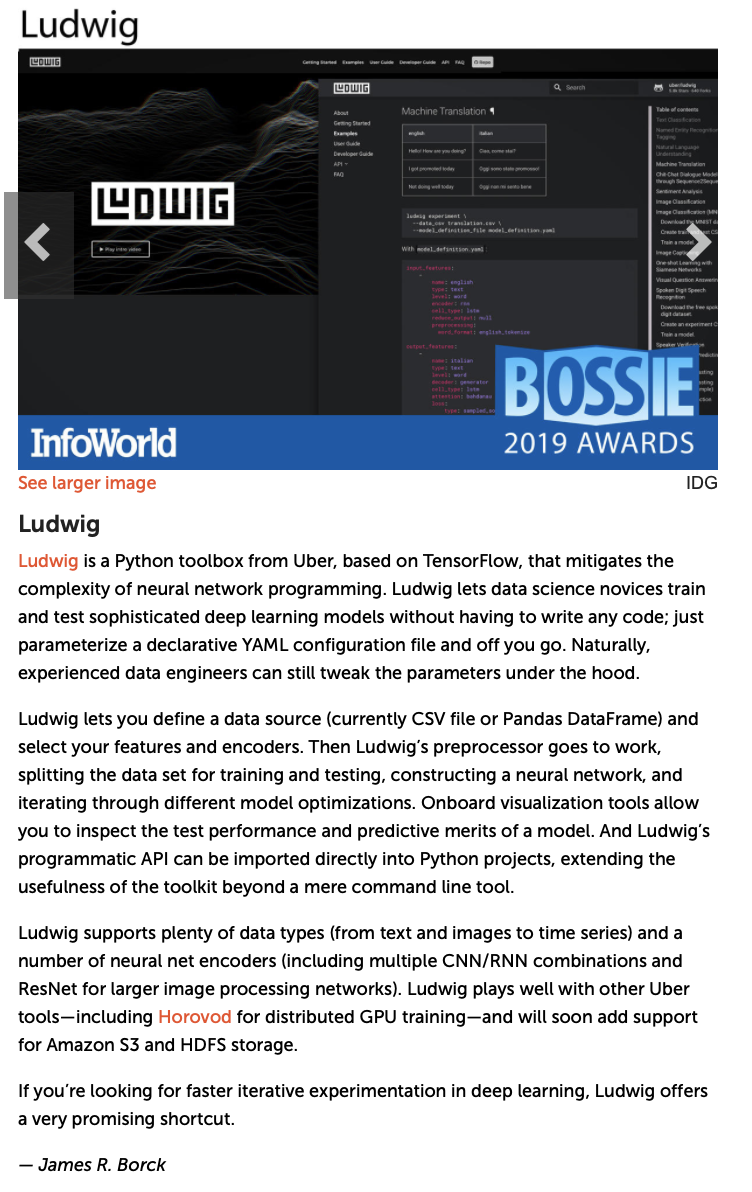
Ludwig wins InfoWorld's BOSSIE award 2019 (screenshot)
Computer Business Review
PureAI
InfoQ
Science: No coding required
Forbes
Towards Data Science: Introduction
Hackaday
Ludwig updates and releases on the Predibase Blog
Full articles
Towards Data Science: Ludwig applications
Domino Data Lab: Practitioner's guide to Ludwig
Interview: On ML, NLP and Ludwig
Hackernoon: 10 must-try open source tools for ML
Marktechpost: Ludwig v0.3
KDNuggets
Coveo: How they used Ludwig for query suggestions
Podcast interviews
InfoQ Podcast with Wesley Reisz
Gradient Dissent - Weights & Biases Podcast
Stanford MLSys Seminar Series
Videos
Official introduction
Uber Open Source Summit Sofia 2019 - in-depth talk
Gradient Dissent - Weights & Biases Podcast (2021)
Stanford MLSys Seminar Series (2021)
Siraj Raval's Deep Learning with No Code
Siraj Raval's AutoML
Suneel Marthi's Beaming Deep Learning with Ludwig
Travis Addair - End-to-End AutoML with Ludwig on Ray (2021)
QCon.ai 2019 San Francisco - full 1h recording
Invited Presentations
- 4/3/2019 Apple
- 6/3/2019 Nvidia
- 28/3/2019 O'Reilly Strata
- 16/4/2019 QCon San Francisco
- 18/4/2019 UC Berkeley Data Science
- 20/4/2019 Uber Open Summit Sofia
- 24/4/2019 Uber Meetup with DSW and Apache Zeppelin
- 19/6/2019 Stanford University
- 25/6/2019 Papis São Paulo
- 20/8/2019 Open Source Summit San Diego
- 20/1/2020 4th Annual Global AI Conference Santa Clara
- 30/1/2020 RE•WORK Applied AI Summit San Francisco
- 8/5/2020 Linux Foundation
- 13/6/2020 Northeastern University
- 29/6/2020 NLP Zurich Meetup
- 7/10/2020 NLP Summit
- 27-30/10/2020 ODSC West
- 26/11/2020 Codemotion
- 3/12/2020 eBay
- 16/12/2020 Open Core Summit
- 11/2/2021 Gradient Dissent - Weights & Biases Podcast
- 18/2/2021 Stanford MLSys Seminar Series